

As part of the Tomorrow’s Schools Review, I propose a new curriculum: Kia Angitu Ki A Koe. This is based on defining success and researching the needs of the future, and is followed by some further environmental changes to put the awe back in education.
Kia angitu ki a koe – success be with you.
- Foundation of success
The Terms of Reference (ToR) talks about the ‘changes we need to make to governance, management and administration in education’. The curriculum is central to all this, therefore it must be the primary concern.
It goes onto mention that ‘the fitness of the school [must] system ensure that every learner achieves educational success’. Success is almost defined in the ToR as ‘when people can discover and develop their full potential throughout their lives, engage fully in society, and lead rewarding and fulfilling lives’ but that is really a test for later in life. I recommend:
“Success is when a school leaver has wellbeing and a good idea of who they, their friends and loved ones are, what the world and society can offer to them and them to it, and how they go about taking their next steps in life”
Central to this must be a degree of personal choice in each learners’ pathway.
- The needs of the future
The needs of the future is a standout theme in the ToR. To distil what this means, I have researched people and organisations from the forefront of futurism to how education translates in practice, from Singularity University to Sue Suckling. The inspiring points are:
- UN Secretary-General Antonio Guterres calls on world leaders to “mobilise the transformative power of the world’s young people”.[1]
- The World Economic Forum says “today’s job candidates must be able to collaborate, communicate and solve problems – skills developed mainly through social and emotional learning[2] … [by way of] foundational literacies,[3] competencies,[4] and character qualities”.[5]
- Tony Wagner has “identified seven survival skills of the future … i.e. skills and mind-sets that young people absolutely need to meet their full potential”. These include agility and adaptability, and initiative and entrepreneurship.[6] Overall, Tony argues that “instead of teaching students to answer questions, we should teach them to ask them”.[7]
- Sue Suckling thinks that for the NZ education system to thrive, learning needs to be self-directed, learner centric, have global participation, rid the linear pathway, have new verification, and focus on the 21st century skills.[8]
- Peter Diamandis thinks passion, curiosity, imagination, critical thinking and grit will be the most important attributes to learn for children to be successful in their adult life.[9] He also thinks the curriculum should be divided into twelve modules[10] including storytelling / communications, and coding.[11] He further advocates for technology and mind-sets about the future including optimism, abundance, and a tolerance for failure.[12]
- Raya Bidshahri says that “we should be teaching our youth with the intrinsic rewards of awe as opposed to the extrinsic reward of grades … this is what’s needed to nurture a generation that is excited to learn, improve themselves, and contribute to human progress. Such is where awe-based education will re-define the entire learning experience”, and “awe-based learning is fuelled by curiosity, imagination, and radical creativity”.[13]
- The ToR even says that ‘the fitness of the school system [must] meet the challenges we face … and the needs of the 21st Century’. In the abstract, these challenges are a more volatile, uncertain, complex and ambiguous world.[14] In the concrete, these challenges are prescribed by goals such as the United Nations’ Sustainable Development Goals.[15]
Kia Angitu Ki A Koe
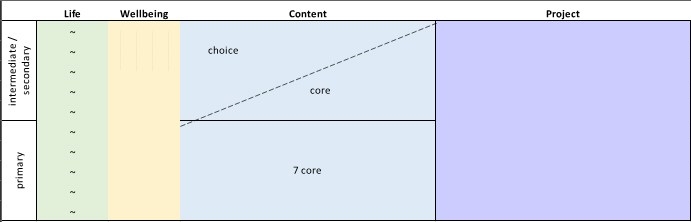
The proposed curriculum of Kia Angitu Ki A Koe is below, followed by some discussion. It is designed to achieve success and meet the needs of the future:
3.1 Life:
Up to 10% of the curriculum is for life modules. Assessment would be for participation.
The aim is for all students to know how to live in the real world once they have left school, regardless of whether they get taught the same at home.
Each year level will generally have at least one life module of varying length, instead of the occasional module at present. The modules would be targeted at different year levels, e.g.:
– Primary school: keeping ourselves safe, cyber security, swimming, money basics, multiculturalism, emotional intelligence, communication;
– Intermediate school: cooking, sewing, woodwork, metalwork, sex;
– Secondary school: sexuality and identity, relationships and consent, the law, budgeting, drugs and alcohol, suicide, spirituality, vastness of space;
– All levels (age appropriate): technology, exponential technology, bullying, and assemblies.
Part of the thinking is that technology and the digital future should be a means and not an end, and that NZ should produce school leavers who are social and interactive people, rather than robots who know how to recite an encyclopaedia.
The life modules are intended as a complement to parents, and the intention is not to over-burden teachers. Accordingly, each module should have an appropriate delivery channel. E.g. keeping ourselves safe should be taught by the police, and sex and sexuality and identity should be taught by qualified people. Some topics could be taught by parents or by VR. For exponential technology, there could be a roadshow to ensure schools don’t each need to spend a lot of money.
Ø Life modules should ensure that school leavers have the minimum survival skills required to live independently and interdependently in the real world. This should result in lower levels of crime, and increased levels of wellbeing.
3.2 Wellbeing:
Up to 10% of the curriculum is for wellbeing. Assessment would be for participation, with merit and excellence to be noted.
The aim is to involve all students in three compulsory strands through all years: regular PE, sports days, and cultural shows. There would also be optional strands such as religion for state integrated schools. This is similar to the present system.
Ø Wellbeing should ensure that school leavers receive a broad and well-rounded introduction to all that life has to offer. This should result in people not slipping through the cracks or becoming too focused on academia at the expense of other aspects of life.
3.3 Content:
About 40% of the curriculum is for content. Assessment is to be gamified, apart from optional international tests for older teenagers.
The aim is to reduce the amount of useless information that children learn by rote, and to free up space in the curriculum for the project module.
There will still be a big focus on compulsory core items at primary school, but there will be seven topics: reading, writing, maths, science, art, history & geography, and either Maori or English. Art is proposed as children love to draw inside and outside the lines. History & geography are proposed so children learn their place in the world. In schools that teach in English, learning Maori should be compulsory. In schools that teach in Maori, learning English should be compulsory. In NZ we need to do with Maori what Wales has done with Welsh.[16]
In secondary school the starting core items will reduce to literature, maths, science, and either Maori or English. Students would take three or four topics per half-year, allowing them to choose other optional subjects. By the end of secondary school, the optional subjects will completely displace the compulsory subjects.
Part of the thinking is to reverse the assessment framework and gamify it in all year levels. E.g. grades should return, and students should achieve higher grades the more sub-topics in a subject that they master. It should be mandatory for schools to provide students with the option of taking an international benchmark exam, like Cambridge, in the last year or so of study.
Ø Content should be about learning information that is part of a basic skill, useful or personally interesting, not learning obscure information that google can answer in a second. Gamifying incentives should increase achievement, and making Maori compulsory will reap massive benefits within one generation.
3.4 Project:
It is proposed to make 40% of the curriculum project-based at all levels of learning. Assessment is to be via peer review, with periodic interviews with an independent teacher who would also help the student work out their personal journey of success (and identify remedial action if required).
The aim is to replicate the work environment, incentivise development of soft skills, reverse the teaching (where the children ask the questions or teach the class), allow children to find their purpose, and let them be aware of the bigger purposes at play in the world.
Students would always work in teams on a project, present that to the class (or wider), and the class would critique and informally review the work. The teacher will have a facilitation and empowerment role, and won’t teach knowledge. Each student would do a number of projects a year, and work with different people each time in differently sized teams, and take different roles.
The project work would be selected by the students from the choices below:
– Sustainable Development Goals and its successor arrangements.
– Local projects.
– Submissions and civil involvement.
– Ethical / moral dilemmas.
– Any NZ-type structure that emerges.
– Apprenticeship.
For SDGs, people might pick a problem to solve, and either scope how to solve it or solve it, or critique and analyse the history of work in a particular area. A local project could be anything safe to do with the community provided that students aren’t used for labour. Submissions and civil involvement may involve making submissions to authorities on matters out for consultation. Ethical / moral dilemmas would be how the students propose resolving a problem, having explored the various options and consequences. Apprenticeships would allow space for older students who want that pathway.
A decade or more of project learning will mobilise the power of NZ’s young people, ensure competencies and character qualities will have been learned, and solve meaningful local and global problems. Students will be self-directed, learner centric, hugely connected, curious, and creative.
Ø Projects should be about exposing students to a wide variety of topics so they can connect to their own mission and be part of something that is larger than themselves, while teaching them about core competencies required in the 21st century and beyond.
- Subsequent changes to the four other themes
Two of the other themes in the ToR will have been addressed as a function of Kia Angitu Ki A Koe – i.e. schools offering flexible and local solutions, and better support for equity and inclusion. Active expression to the Treaty of Waitangi for Maori medium students is flipped on its head to make all English medium students learn Maori – noting the flow on impact for Maori of a more broad-based societal understanding of their language and culture (and the Treaty).
The remaining theme is the environment within which schools operate, and a number of flow-on arrangements stemming from Kia Angitu Ki A Koe are proposed:
- Schooling should be compulsory for children when they turn five, not six.
- Distance learning should only be allowed in exceptional circumstances, e.g. if a student cannot get to a school within, say, a one hour drive or boat trip.
- Student reports should be realigned to reflect Kia Angitu Ki A Koe.
- Teachers should receive a step change increase in base pay to reflect the value they provide to the life-cycle of the economy. There should also be allowances paid to teachers in parts of the country with significantly higher costs of living than most other regions. There should be material and contestable bonuses awarded to, say, 20% of teachers each year.
- Teacher training, both prior to becoming a teacher and during teaching, will need to be fit for purpose, including an increased emphasis on facilitation.
- Schools should receive extra funding to hire roving project teachers to assist classroom teachers (at primary level) or students (in secondary school) choose projects to do and help troubleshoot, and do the formal assessments or success guidance.
- Schools in low socio-economic areas should receive extra funding to supply breakfast to school children who may require it.
- Schools should be required to do an annual report to the Ministry on how well it is going in achieving the curriculum in each year group (in general).
- Schools should be required to incorporate the following principles in their strategic plans which boards shall be responsible for: friendship, awe, tolerance of failure, sense of optimism, and abundant mind-set.
- School boards should ensure compulsory retirement when two terms have been served by individual members (including the chair).
- ERO should take on a greater role in ensuring that the standard of teaching life modules and facilitating project modules is consistently high.
- NZQA should take on a changed role. It should be responsible for ensuring student’s achievement in project modules is captured in a personal block-chain. It should also set the sub-tasks in each subject at each year level that need to be completed to achieve gamified grades. It should then ensure that the standard of grading is consistently applied.
- ERO and NZQA could even be merged.
- Some central agency should be responsible for providing a database of centralised project ideas for students and teachers who are stuck. They can also train the teachers in the various project frameworks. They could also tap into concepts like HundrED[17] which is an international MOOC. They could also have a role to co-ordinate shared service provisions relating to technology or the shared use of project teachers.
- The Ministry should be responsible for ensuring the framework stays relevant in real time (rather than waiting for 30 year reviews), by way of staying across international trends and future thinking, and, subject to smaller consultation processes, amending parts of the framework as appropriate.
- Wide consultation must not let great ideas slip
There were more than 13,000 submissions on the government’s recent Zero Carbon Bill.[18] Similarly, the Tomorrow’s Schools Review’s ToR requires it to consult widely and it, too, may receive a large number of submissions. It is therefore critical that overall trends, and bespoke ideas, all have the same chance of being adopted. If it is just the former, then great ideas may slip through the cracks.
To address this, perhaps the Taskforce could consider consulting on the top 20 or 50 ideas in its next steps – either by way of bespoke suggestions, or frameworks put together from overall trends.
Conclusion
A solution like Kia Angitu Ki A Koe is within our grasp as a country. Such a solution would address the ToR points, and deliver the required benefits to tomorrow’s students and wider society.
[1] https://www.un.org/development/desa/en/news/intergovernmental-coordination/closing-of-global-goals-forum.html
[2] https://www.weforum.org/agenda/2016/03/21st-century-skills-future-jobs-students/
[3] I.e. literacy, numeracy, science, ICT, finance, and cultural and civic literacy.
[4] I.e. critical thinking / problem solving, creativity, communication, and collaboration.
[5] I.e. curiosity, initiative, persistence / grit, adaptability, leadership, and social and cultural awareness.
[6] The other five are curiosity and imagination, assessing and analysing information, effective oral and written communication, critical thinking and problem solving, and collaboration across networks and leading by influence.
[7] https://singularityhub.com/2017/07/04/7-critical-skills-for-the-jobs-of-the-future/#sm.001gi55us10xzdtaqel1o9ja30ya3
[8] SingularityU Summit in Christchurch in 2017.
[9] http://www.21stcentech.com/peter-diamandis-shares-views-education-21st-century-part-1-issues-guiding-principles/
[10] http://www.21stcentech.com/peter-diamandis-shares-views-education-21st-century-part-2-curriculum/
[11] The other ten are passions, curiosity & experimentation, persistence / grit, technology exposure, empathy, ethics / moral dilemmas, reading / writing / maths, creative expression & improvisation, entrepreneurship & sales, and language.
[12] http://www.21stcentech.com/peter-diamandis-shares-views-education-21st-century-part-4-mindsets-future/
[13] https://singularityhub.com/2017/12/04/let-me-blow-your-mind-the-importance-of-awe-in-education/#sm.001gi55us10xzdtaqel1o9ja30ya3
[14] https://chiefexecutive.net/understanding-vuca-environment/
[15] https://sustainabledevelopment.un.org/?menu=1300
[16] https://www.walesonline.co.uk/news/wales-news/welsh-language-living-breathing-beautiful-13574718
[17] https://www.fastcompany.com/3067189/this-is-how-a-finnish-education-platform-will-scale-innovation-for-the-next-100-years
[18] https://www.maoritelevision.com/news/politics/zero-carbon-bill-submissions-exceed-13000
 Chris Boxall