

Appendix 11 – Setting the elephants free: One idea to solve New Zealand’s net zero carbon goal
It is all very well fixing omissions and implementing the primary ways to reduce emissions (both of which should happen), but the ultimate aim is to get rid of the elephants by setting them free back into the wild. I have an idea…
If the CCC draft report is synthesised into one concept it is that New Zealand is trying to solve ongoing permanent emissions (from fossil fuels etc.) using offsets from a temporary emissions sink (from forests). So a systems view of that says: okay, how do we make forests act like permanent sinks? Once framed this way, the answer seems obvious yet counter-intuitive at the same time: bury logs deep in the ground. The impact of that would be as follows for a contiguous forest cycle:
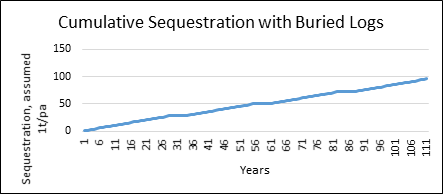
I.e. permanent sequestration (the flat lines are assumed emissions release from some biomass as energy or nutrients). Conceptually, the idea would fit into the existing ETS, provide ongoing incentives for forestry investments, use the value-add of wood locally rather than exporting it, and not destroy the manufacturing or agriculture industries if new technology is not invented or used quick enough. In essence, the proposal is to do biomimicry to replicate the fossil fuel creation process, using nature. It is crazy / creative, but is not unheard of internationally.[1]
The idea has limitations, e.g. it is best suited to exotics, it will take energy to build holes or tunnels or mountains, it will cost money, the net carbon balance (carbon sequestered in the stored logs vs. carbon emitted to create the covered hole for the logs) needs to stack up, the land would need to be unproductive and without risk of earthquakes, and there would need to be no physical carbon leakage. But these are details at ideas stage. Maybe more systems thinking could also be used: process the trees and inject carbon into abandoned oil reservoirs to limit the mass to bury. The solution might buy New Zealand 1,000 years of net sequestration while in the meantime gross emissions could be reduced using efficiency, consumption reduction and other technology.
I would like to see this idea (and others) wholly fleshed out and put on the abatement curve. I have no idea where it would fit, but it feels low-cost, low-tech, and scalable. And if it works, it may well prove to the world that achieving absolute decoupling of emissions from GDP is possible.
In any case, what the CCC needs in addition to science is ideas – lots of ideas – and openness to bounce those around without discounting them straight away. I suggest an ongoing innovation incubator process that benefits the social good not entrepreneurs, maybe using design thinking. Today’s ideas are tomorrow’s innovations which are next week’s science.
[1] https://www.washingtonpost.com/business/2019/06/12/new-plan-remove-trillion-tons-carbon-dioxide-atmosphere-bury-it/
 Chris Boxall