

Appendix 10 – Forestry is flawed because of harvested wood products, and that must be overhauled using first principles science about forestry emissions and removals.
Intro
Pull back the foliage of carbon accounting and there is a third elephant hiding and it may be the biggest of the three. It is definitely the most complex.
The CCC…
- Says “Forestry … emissions and removals occur decades after the initial decision to plant. … The repeated growth and harvesting of this forest means that the country’s net emissions [from forests] will cyclically go up and down over decades.”[1]
- Says “New exotic plantation forests absorb carbon quickly, but much of this is released when these are harvested”[2] … “on a 28 year [harvest cycle].”[3]
- Says “New permanent native forests absorb carbon more slowly but will continue to do so for centuries until they reach maturity.”[4]
- Says “relying too heavily on forestry removals to offset emissions … would require ongoing conversion of land to continue offsetting emissions and put the burden of reducing gross emissions on future generations.”[5]
Discussion
- “New Zealand is the first, and [as of 2018] the only country in the world to include forestry in a national ETS.”[6] By this, the point is that it is okay to account for land-use and forests in national carbon accounting systems, but taking the added step to give units and require surrender for forests on harvest is unique, globally.
- It should not surprise that New Zealand has a stockpile of NZUs. “Of this Stockpile [in 2020], 39% (51 million NZUs) are held by forestry participants who are unlikely to sell as credits are … retained to cover … harvesting and … future land use change options.”[7] Of the inferred stockpile of 131 million NZUs, there is poor information about who holds the other units.
- What is driving the forestry part of the stockpile?
- Pre-1990 forests receive a one-off bunch of NZUs so that the forests stay as they are in successive harvest cycles, or the foresters pay the cost of carbon for the emissions caused by land-use change.[8]
- Until recently, post-1989 forests could opt-in and receive NZUs using a ‘land-use method’ as the forests grow which requires surrender of a significant[9] amount of those units on harvest.[10]
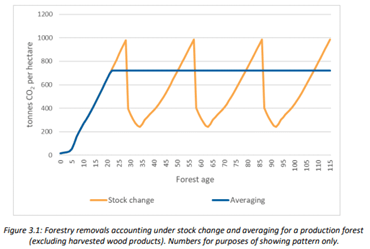
- The ETS has been amended such that post-1989 forests will receive NZUs using an ‘averaging method’ as the forests grow to average height with no surrender of units on harvest.[11] However, the net impact of NZUs using a land-use or averaging approach for post-1989 forests should be the same or very similar,[12] [13] as shown below:[14]
- But it is very strange for forests to receive NZUs when they are carbon neutral. The reason for that seems to be as a planting incentive,[15] similar (but opposite) to the now repealed 1 NZU unit surrender for every 2 tonnes of emissions from the Act for stationary energy.
- Hold on, forests are carbon neutral? Yes, because:
- As summarised by the MfE:[16] “As trees grow, they absorb carbon dioxide … and store it in their trunks, branches, leaves and roots… When trees are harvested, carbon that is stored is released back into the atmosphere as the wood decays. At present, all harvested wood taken off site is conservatively assumed to be immediately released back into the atmosphere. Harvest residues that remain on-site are considered to decay completely over a 10-year period, under NZ conditions.”
- When trees die, they release their stored carbon back into the atmosphere or soil.[17]
- “All … trees that survive are expected to achieve carbon neutrality over their … life.”[18]
- Yet that conflicts with the CCC which says “if viewed over the long-term, production forests deliver no additional carbon sequestration benefits after the first rotation, as the carbon sequestered as they grow is emitted after they are harvested.”[19] However:
- The first rotation will still release all its stored carbon.
- To look at a production cycle of forests, one needs to have the start and end point the same. Going ‘plant-harvest-plant’ to conclude a sequestration benefit is dubious.
- Net zero carbon on a cumulative basis is net zero carbon, even if that might show a temporary decrease (or increase) in emissions compared to a base period.
- The CCC even refutes itself: “the repeated growth and harvesting of … forest means that the country’s net emissions will cyclically go up and down over decades.”
- So what is going on here? Statistics. If land-use accounting is used, and it is assumed that forests release all emissions the moment they are felled, then the graph looks like this:
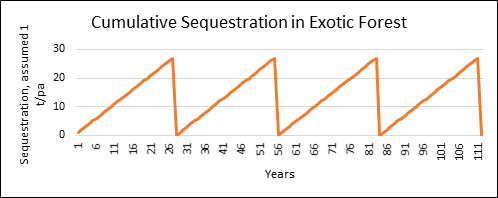
- As this is a line graph, not a bar graph, cumulative emissions of zero at the end show that forests are net zero carbon and emit the same quantity of carbon that they sequester, and are therefore temporary in nature. Why is that different from the previous graph? Because this one includes emissions released from harvested wood products.
- The following graph shows what happens if harvested wood products take 14 years to release the carbon, during which time the forests are replanted (for simplicity and to illustrate the point, all emissions release is assumed to be harvested wood products):
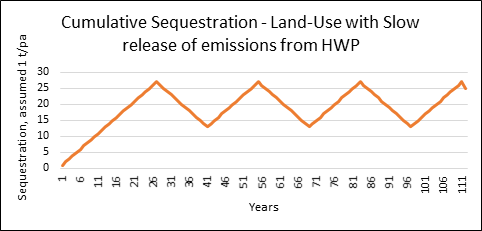
- This graph shows that replanted forests sequester carbon which offsets the amount being released. It suggests that forests are net sinks, even with harvested wood products included. However, to reach that conclusion requires us to forget about the dip in emissions after year 111 (down to zero) if the forest is not replanted. While it could be argued that deforestation will be accounted for anyway if it happens, the point is that cumulative emissions including the impact of deforestation should still be zero.
- Then there is the argument that forests will be replanted forever (i.e. no deforestation), in order to capture the benefit of deferred emissions from harvested wood products as modelled above to prove that forests capture emissions from their first rotation. However, such an argument is impossible because everything has an end date. Either the sun will expand in 1-2 billion years and kill the trees,[20] or, likely to happen much sooner, the Act will be repealed. Under the first scenario, deforestation will cause net emissions from that cycle of forests to be zero. Under the second scenario, emissions from harvested wood products will cause net emissions from that cycle of forests to be zero because they won’t be offset by the next planting (even if that happens) because the Act will no longer apply. To overcome all of this, statistics would suggest correcting for that anomaly by way of either accounting for it at the start of the period, or not according forests any net sink or emitter status.
- Another way to look at this is with averaging. Recall the graph in point iv. with the comparison of land-use accounting with averaging (setting aside that it does not seem to have regard for the statistical anomaly discussed above and excludes harvested wood products). The key point is that a forest, with its many cycles, appears to store a fixed amount of carbon, say 750 t. However, to lock in that benefit it needs to be assumed that the forest lasts forever. If we assume forever is 750 years, then forests sequester 1 t/pa or about 0.1% of gross sequestration from one plant cycle. If we assume forever is 750,000 years, then forests sequester 0.001 t/pa. Therefore even if forests are a net sink, an averaging accounting method should see new forests’ sequestration approach zero as the average of their ‘forever’ life-cycle net sequestration is spread over the same time period.
- Compare the points above with this CCC statement: “Aotearoa’s NDC will use averaging to account for emissions and removals by post-1989 forests from 2021.”[21] The underlying impact of that across the forest stock looks like this:[22]
- The graph (across many exotic forest cycles) looks wrong because forests (and even the accounting of forests with harvested wood products excluded) approaches net zero carbon over time. When harvested wood products are included then the forests will get even closer to net zero carbon over time – so why is there net sequestration, particularly when there will not be much marginal land for new forest plantations after 2050?
- It does seem like the CCC is using the government’s logic. I.e. “removals from post-1989 forests will only be accounted for up until the forests reach their long-term average carbon stock. Emissions and removals from further growth, harvesting and replanting will not be accounted for in the same way. The first NDC states that once a forest has passed its long-term average carbon stock, it will move to the forest management category where it will be accounted for under a business-as-usual reference level, just like pre-1990 forests.”[23] That has been disproved in xi. through xiii. above; it only works if mathematical logic is bent.
- New Zealand’s NDC does[24] refer to the 2006 IPCC Guidance which says[25] “Below-ground carbon stock changes, as a default assumption consistent with the 1996 IPCC Guidelines, can be zero.” That means that above ground stock changes are also zero if sequestration is then covered by harvested wood products. However, “the NZ Harvested Wood Products Model currently meets international inventory reporting requirements,”[26] but that does not mean that international agreements honour the science. Ironically, formative international processes said “the default assumption was initially that wood products removed at the time of harvest should be recorded as an immediate emission of CO2, with additions to the HWP pool assumed to be balanced by losses,”[27] probably to reflect the zero carbon nature of forests. But then “The Kyoto Protocol [said] Harvested Wood Product … changes were not allowed to contribute towards targets for the first … commitment period.”[28] The result was therefore that “the default … IPCC methodology … [did] not require tracking of the full life cycle of carbon from trees through products to disposal and ultimate return to the atmosphere.” [29]
- Going forwards, the CCC then says a number of things:[30]
- “HWPs for post-1989 forests are likely to be incorporated into averaging through adjusting the long-term average carbon stock.”[31]
- “… all of the carbon returns to the atmosphere eventually, [therefore] including HWPs in emissions accounting helps capture this effect and recognises the benefit of using timber in the built environment.”
- “The NDC accounting will include HWPs but the exact details have not been confirmed.”
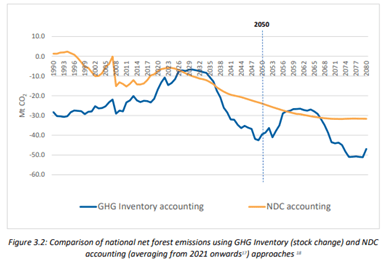
- Finally, (notwithstanding all the earlier points) the CCC seems to be modelling the net impact of forest sequestration, ignoring both the emissions from deforestation and from temporary felling. But this is how forests work and even the CCC says forest emissions go up and down from sequester to emissions. Therefore the chart[32] below just looks wrong:
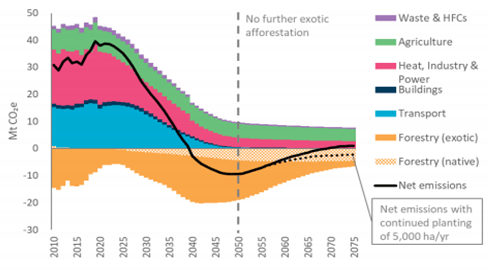
- It has to be wrong because there has been some deforestation, even net emissions in some years, as per this CCC chart:[33]
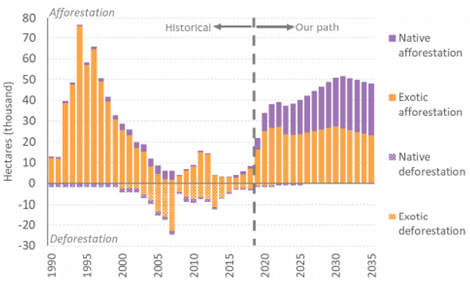
- Perhaps the CCC can explain this with some sort of “gross-net” or “net-net” method[34] but that is confusing, complex, not transparent and not reflective of the science.
- It also raises a question about why 1990 is the base level for some forests and forest management accounting techniques when the Paris Agreement says to “limit the global average temperature increase to 1.5°C above pre-industrial levels.”[35] Therefore shouldn’t the base year be the last year of pre-industrialisation? What about the carbon emitted (or sequestered) between that point and 1990?
Conclusions
- It is not clear whether New Zealand has failed to wholly account for harvested wood products in national emissions accounting prior to 2020.
- But going forwards, under Paris and the NDC, it seems like the CCC and government forestry emission projections have excluded harvested wood product emissions and possibly got the accounting wrong.
- If harvested wood product emissions are incorporated into averaging as the CCC suggests, then that should account for the full cycle of sequestered and emitted carbon. It could be argued that it is very slightly positive if new forests grow while old forests emit (thus making the first rotation carbon positive), but from a systems perspective that requires ignoring the second law of thermodynamics (which says everything ends) and ignoring emissions from milling. In any case if the benefit of one forest’s rotation is spread over a long time, the net carbon sequestered approaches zero. In other words, the average of net zero carbon forests on a cumulative basis (be it averaging or land-use) is, or approaches, zero once the life-cycle of forests is wholly accounted for.
- Forests are net zero carbon themselves over time, and are a temporary sink that only buys time.
- Any attempt to account for forests as a net permanent carbon sink requires tricky assumptions and accounting.
- The NZU incentives supplied to foresters are (or should be) different from forestry emissions accounting. NZU incentives could be net positive (even though forests are carbon zero) so as to incentive planting, which is a good idea to buy time to permanently sequester carbon.
- However, forestry does not seem to fit neatly into the ETS, if indeed it ever properly has.
- There is a reasonable argument to exclude forestry from ETS emissions accounting, or include it using a gross sequestration and emissions approach (not averaging) where the net of each forest cycle is zero over time regardless of the assumptions on release of emissions. This has merit because many of the actuals emissions from harvesting forests in New Zealand occur overseas, suggesting if forests are included as land-use it will align with a hybrid or consumption carbon accounting framework.
- There is a reasonable argument that forestry should be removed from the ETS unit entitlement and surrender process, given it is basically a zero-sum game. Failure to do that would cause dis-alignment with concepts that the Act has been keen to fix, i.e. 1 unit for 1 tonne of emissions or sequestration. There must be other ways to incentivise forests.
- Graphs of gross emissions and sequestration should not include net emissions within the gross numbers as that conflates the concepts and hides the science.
- Strategic issues (like forestry causing a large stockpile of NZUs) should not be solved using an operational tool (like reduced NZU units at auctions).
- The lack of information on who else holds stockpiled units deprives the market, the CCC and the government, of information, and that risks poor assumptions.
- Extrapolate that point and the New Zealand economy is at risk of international climate justice attacks, e.g. annual units at auction in 2021 including the cost containment reserve, of 25 million units * $100/NZU and it would only cost an international participant $2.5b to bring the New Zealand economy to its knees by depriving permits from domestic emitters.
- Reflecting on this section in total, it is not presented anywhere (in simple science terms) how each temporary and permanent emission and sequestration process works from a gross and net perspective. The complex should be simplified.
Recommendations
- Form a view that the impact of including harvested wood products in emissions accounting and budgets should lead to averaging of, or approaching, zero in forests to honour the big picture that forests approach net zero carbon.
- Form a view that if averaging is not used going forwards, and land-use is, then despite likely detail and complexity on assumptions and point of accounting, each forestry system should include the inevitable end-of-life release of emissions such that forests will be net zero carbon.
- Discuss in the report whether the accounting and incentives relating to forests are the same concepts and if so, decouple them.
- Be bold and talk openly about historical mistakes and errors if there are any.
- Recommend land-use accounting for forests to reflect what actually happens with emissions.
- Recommend an overhaul of how forests are accounted in emissions reporting and emissions budgets so that regardless of the accounting method used, each forest better reflects its temporary sink status.
- Recommend a review of whether forestry should be in the ETS from a unit and surrender perspective (not an accounting perspective). As part of that, consider how to unwind the impact of forestry having been included in the ETS (from a unit and surrender perspective) to date. Also consider how else forestry can be incentivised, or whether it should be given it approaches carbon neutrality.
- Recommend restating 1990-2020+ net and gross emissions when forestry better approaches net zero carbon neutrality over time (if required). I.e. if harvested wood products have been excluded in prior periods even if allowed under the Kyoto protocol. It is important to get the data and the science consistent.
- Fix the forestry graphs so they make sense.
- Change all the models, graphs and discussion in the report to properly disclose the gross emissions and sequester concepts of forests, and not to net that down as that limits debate and hides the science.
- Recommend more research on the types of trees best for sequestrating carbon in Aotearoa, the warming potential of darker soil caused by increased carbon sequestration, and the risks that sequestration in forests will reduce over time as global temperatures increase.
- Explain forests in more simple terms.
- Explain in plain English and simple science terms how emissions and sequestering works for each form of abatement on a gross and net basis over time.
- Extend the forestry (and emissions) graphs out to 2500 to see what the cycles really are, and just how technology will be required in subsequent periods.
- Encourage the various government departments to align on their understanding of forests.
- Advise the government that the CCC considers that a lack of understanding on science as it fed into emissions reductions plans will not count as a “significant change of circumstance” which is required pursuant to r5Z(2) if there are problems and more offshore mitigation by buying overseas units is required.
- Recommend that international parties (i.e. those who do not have domestic gross emissions) cannot hold NZUs so as to mitigate the economy from adverse trading shocks. As part of that, consider how to unwind the impact of international parties presumably holding stockpiled NZUs at present.
- Recommend that the government release regular information about categories of holders of stockpiled NZU units.
[1] Page 151 of the draft report.
[2] Page 48 of the draft report.
[3] Page 138 of the draft report.
[4] Page 48 of the draft report.
[5] Page 34 of the draft report.
[6] Page 19 of https://www.treasury.govt.nz/sites/default/files/2018-08/ria-mpi-etsf-aug18.pdf
[7] https://www.cooneyleesmorgan.co.nz/NZ-emissions_trading_scheme
[8] https://www.mfe.govt.nz/climate-change/new-zealand-emissions-trading-scheme/participating-nz-ets/forestry-nz-ets/how
[9] https://interpine.nz/ets-new-method-of-carbon-accounting-averaging/
[10] Page 140 of the draft report.
[11] Page 139 of the draft report.
[12] https://www.beehive.govt.nz/release/ets-revamp-averaging-accounting-forests
[13] https://interpine.nz/ets-new-method-of-carbon-accounting-averaging/
[14] Page 18 of the CCC’s Chapter 3 Evidence.
[15] https://www4.unfccc.int/sites/ndcstaging/PublishedDocuments/New%20Zealand%20First/New%20Zealand%20first%20NDC.pdf
[16] https://www.mfe.govt.nz/climate-change/new-zealand-emissions-trading-scheme/participating-nz-ets/forestry-nz-ets/how
[17] http://hiilipuu.fi/articles/carbon-cycle
[18] https://meridian.allenpress.com/jeh/article/34/4/101/80299/How-Green-Are-Trees-Using-Life-Cycle-Assessment
[19] Page 19 of https://ccc-production-media.s3.ap-southeast-2.amazonaws.com/public/evidence/advice-report-DRAFT-1ST-FEB/Evidence-CH-03-how-to-measure-progress-20-Jan-2021.pdf
[20] https://www.forbes.com/sites/startswithabang/2020/02/08/ask-ethan-will-the-earth-eventually-be-swallowed-by-the-sun/?sh=3dcb226b5cb0
[21] Page 20 of the CCC’s Chapter 3 Evidence.
[22] Page 18 of the CCC’s Chapter 3 Evidence.
[23] Page 17 of https://ccc-production-media.s3.ap-southeast-2.amazonaws.com/public/evidence/advice-report-DRAFT-1ST-FEB/Evidence-CH-03-how-to-measure-progress-20-Jan-2021.pdf
[24] https://www4.unfccc.int/sites/ndcstaging/PublishedDocuments/New%20Zealand%20First/New%20Zealand%20first%20NDC.pdf
[25] Page 4.15 of https://www.ipcc-nggip.iges.or.jp/public/2006gl/pdf/4_Volume4/V4_04_Ch4_Forest_Land.pdf
[26] https://cbmjournal.biomedcentral.com/articles/10.1186/s13021-020-00144-5
[27] https://cbmjournal.biomedcentral.com/articles/10.1186/s13021-020-00144-5
[30] Page 24 of https://ccc-production-media.s3.ap-southeast-2.amazonaws.com/public/evidence/advice-report-DRAFT-1ST-FEB/Evidence-CH-03-how-to-measure-progress-20-Jan-2021.pdf
[31] Page 142 of the draft report.
[32] Page 16 of https://ccc-production-media.s3.ap-southeast-2.amazonaws.com/public/evidence/advice-report-DRAFT-1ST-FEB/Evidence-CH-08-what-our-future-could-look-like-28-Jan-2021-compressed.pdf
[33] Page 68 of the draft report.
[34] Page 19 of https://ccc-production-media.s3.ap-southeast-2.amazonaws.com/public/evidence/advice-report-DRAFT-1ST-FEB/Evidence-CH-03-how-to-measure-progress-20-Jan-2021.pdf
[35] Page 71 of the draft report.
 Chris Boxall