

Appendix 1 – Economic modelling says CO2 emissions will go down and GDP will go up, but historic sustained global material absolute decoupling of emissions and GDP has never happened.
Intro
Few people realise that absolute decoupling is an elephant in the room, but it is and it’s big.
The CCC…
- Says “[the impact of its] proposed emissions budgets [is about] … 1% of projected GDP.”[1]
- Says “energy consumption and GDP [are] … closely linked … Some countries have managed to break this link, but Aotearoa has not yet managed to achieve this.”[2]
Discussion
- Emissions are also very closely linked with GDP at a global level (see below).[3]
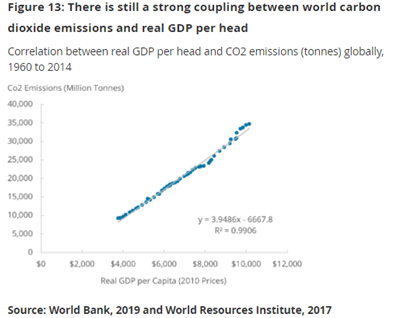
- GDP has increased globally over the years, as has population, and therefore as has emissions.[4] The world has increased emissions in order to improve a range of quality of life outcomes. GDP is also good proxy for economic growth and wellbeing.
- Therefore in order to achieve global emissions reductions, the world could reduce GDP (as the graph above shows, if the line is followed from right to left). However, the problem with that is that that would also reduce quality of life and wellbeing outcomes.
- The other way of achieving global emissions reductions is to sufficiently decouple emissions from GDP.
- However, a scientific analysis of three meta-analyses looking at the Environmental Kuznets Curve concludes that “there has never been a global pattern of absolute decoupling of CO2 from economic growth.”[5] [6]
- The same paper concludes (p24-26) that some countries have managed to break this link, however that tends to be small in either outcomes, geography or time period, i.e. these are temporary anomalies.[7] Therefore any statement that a country has achieved sustainable absolute decoupling of emissions and GDP is misleading. The classic example is the UK which did reduce emissions by 40% below 1990 levels and increase its GDP by 66% but:[8]
- A large reason for that was outsourcing production (aka carbon leakage) to, e.g. China.
- Emissions actually increased by 30% from 1990 to 2007 when this is factored in.[9]
- That’s the past – what about the present: NZ’s emissions reduced 41% during the first COVID-19 lockdown in early 2020.[10] However, not only was that not even close to eliminating emissions but it came at an arguably unsustainable change to lifestyles. Not surprisingly when GDP resumed following lockdown, so did emissions,[11] as they are coupled.
- And the future? “Global-scale, long-lasting and absolute decoupling may not be possible.”[12] “There is no blueprint for growth without emissions.”[13]
Conclusions
- The economic modelling that NZ can achieve net zero carbon and grow the economy by 74% between now and 2050[14] is wrong based on current human knowledge because evidence says that historic sustained material global absolute decoupling of emissions and GDP has never happened.
- Sustainability science says that GDP (and production and consumption) will need to reduce from today if emissions are to reduce.[15] Alternatively, new science, technology and innovation will need to be used or invented to drive actual emissions reductions.
- Honesty is required with Aotearoa about what the Act (including its scientific difficulties and paradoxes) really means.
- It is not clear whether the CCC’s existing GDP projections are a flat line to 2050 or dip then increase. Absolutely decoupling of emissions and GDP must be wholly discussed and understood.
- It is not credible to accurately model or solve a problem created by traditional economics with traditional economics, because the assumptions will be skewed by a fundamental misunderstanding of multi-disciplinary holistic ways of viewing the world. Neither is it credible to use similar (arguably flawed) international traditional economic analyses to prove that a New Zealand traditional economic analysis is good and/or accurate.
Recommendations
- Change the economic model to align with sustainability science or make it clear that while traditional economics models a 1% impact on GDP by 2050, sustainability science calls that massively into question.
- Explain how absolute decoupling of emissions and GDP will happen in Aotearoa when that has not happened before on a global, material, sustainable level.
- Discuss the uncertainties and risks in relation to absolute decoupling of emissions and GDP. E.g.: What is the impact of reduced GDP on quality of life outcomes and the distribution of inequality? What happens to emissions if the country keeps increasing GDP growth?
- Analyse, graph and discuss New Zealand’s Environmental Kuznets Curve using both a production and consumption approach.
- Add percentage changes in GDP into the key net emissions graphs[16] and bring that into the body of the report, so everyone can understand the modelled trajectory of GDP destruction or growth over time vs. the net emissions trajectory.
- Commit to commenting on and monitoring GDP vs. emissions a key part of the CCC’s role in coming years, including holding itself to account on its prior advice.
- Recommend that the Productivity Commission advise how sustainable absolute decoupling can happen given the synergies between that and the implied sustainability obligations in the Productivity Commissions’ purpose[17], and/or propose that the New Zealand Productivity Commission Act 2010 is amended to consider climate change and sustainability.
- Recommend that the Prime Minister’s Chief Science Advisor provides advice on the emissions reductions plans that are proposed by the government on the back of the CCC’s work to ensure that those plans are fit for scientific purpose.
- Obtain proactive input from the Prime Minister’s Chief Science Advisor in all future reports and analyses.
- Recommend a policy direction to increase funding for universities and research and development on specific scientific concepts and paradoxes associated with climate change and sustainability.
[1] Page 18 of the draft report.
[2] Page 38 of https://ccc-production-media.s3.ap-southeast-2.amazonaws.com/public/evidence/advice-report-DRAFT-1ST-FEB/Evidence-CH-17-direction-of-policy-for-Aotearoa-21-Jan-2021.pdf
[3] www.ons.gov.uk/economy/nationalaccounts/uksectoraccounts/compendium/economicreview/october2019/thedecouplingofeconomicgrowthfromcarbonemissionsukevidence
[4] www.gapminder.org/videos/200-years-that-changed-the-world/ and www.gapminder.org/tools/
[5] Page 24 of www.researchgate.net/publication/334453443_Decoupling_Debunked_Evidence_and_arguments_against_green_growth_as_a_sole_strategy_for_sustainability_A_study_edited_by_the_European_Environment_Bureau_EEB
7 Pages 24-25 of the same paper does show absolute decoupling of other greenhouses gases, but at levels insufficient to limit global warming to 1.5⁰C.
[7] The paper also finds examples of relative decoupling (where GDP grows, and emissions grow but at a lesser rate than GDP growth) – but that only slows emissions growth and does not reduce emissions.
[8] www.positivemoney.org/2020/02/the-uks-decoupling-delusion-have-we-really-divorced-economic-growth-and-carbon-emissions/
[9] The same paper does show (p26) that the UK’s emissions did fall from 2007 to 2015 on both a production and consumption basis while GDP increased slightly. However that was likely due to further displacement of coal, suggesting that any absolute decoupling may stop or become very difficult when coal abatement stops.
[10] www.newshub.co.nz/home/new-zealand/2020/05/coronavirus-the-jaw-dropping-impact-new-zealand-s-covid-19-lockdown-had-on-carbon-dioxide-emissions.html
[11] www.stuff.co.nz/environment/climate-news/124269358/why-2020s-lockdowns-hit-the-economy-worse-than-they-hit-pollution
[12] www.eea.europa.eu/themes/sustainability-transitions/drivers-of-change/growth-without-economic-growth
[13] https://www.dropbox.com/s/4bflogr9wzy3mcm/Growth%20without%20economic%20growth%20webinar.mp4?dl=0 at between the 27 and 28 minute mark.
[14] Auckland CCC workshop during February 2021.
[15] Assuming that reducing population is off the table.
[16] Pages 16 & 17 of https://ccc-production-media.s3.ap-southeast-2.amazonaws.com/public/evidence/advice-report-DRAFT-1ST-FEB/Evidence-CH-08-what-our-future-could-look-like-28-Jan-2021-compressed.pdf
[17] Which is “to provide advice to the Government on improving productivity in a way that is directed to supporting the overall well-being of New Zealanders…” at www.productivity.govt.nz/about-us/
 Chris Boxall