

Appendix 2 – A perfectly circular economy is impossible because of the second law of thermodynamics, so a key solution must be about efficiency.
Intro
The cheapest and most pragmatic way to reduce emissions is to make the world’s use of resources more efficient.[1] It will never be perfectly efficient because a circular economy is not a panacea.
The CCC…
- Says that “In our vision… Aotearoa has a circular economy and generates very little waste.”[2]
- Says that “Reusing and recovering waste materials is a key part of a circular economy.”[3]
- Recommends to “Accelerate light electric vehicle uptake.”[4]
Discussion
- A circular economy “Design[s] out waste & pollution, keep[s] products & materials in use, [and] regenerate[s] natural systems.”[5] However, despite its popularity, the term ‘circular economy’ is fledgling, e.g. in 2019, Finland’s degree of circular material reuse was 4.6%.[6]
- The second law of thermodynamics “is about the quality of energy” and “it states that as energy is transferred or transformed, more and more of it is wasted … and there is a natural tendency of any isolated system to degenerate into a more disordered state.”[7]
- The above points come together when we consider EVs. There is conflicting science[8] about the life-cycle emissions from EVs in Germany – EVs pollute more than diesel cars vs. EVs pollute 43% less than diesel cars. Yet that is a red herring – the key point is that EVs create emissions when produced and consumed unless both processes run on 100% clean energy.
- EVs use lithium. Australia currently recycles 2% of its lithium-ion waste.[9] Factors influencing this are that cathodes degrade over time and it is hard to separate out the different metals without burning it, which loses a lot of lithium mass.[10]
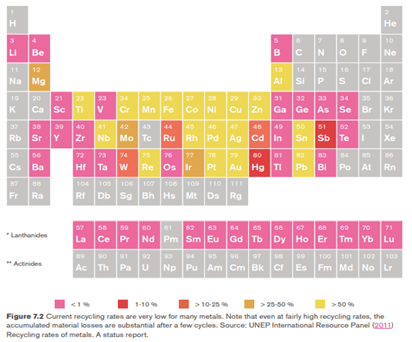
- 100% recycling and reuse of something in its same form forever is not possible. E.g. plastics can only be recycled 2-3 times before it needs to be down-cycled into a lesser product.[11]
- The current level of recycling rates of elements from the periodic table are noted below:[12]
- Then let’s look at solar power. The second law of thermodynamics applies as solar cells are 30-40% efficient[13] and tend to last 20-30 years[14] before having to be replaced. While silicon (the main component in most solar cells) makes up about 30% of the earth’s crust,[15] it is difficult to recycle. “By 2050, the International Renewable Energy Agency projects that up to 78 million metric tons of solar panels will have reached the end of their life … [with] 6 million metric tons of new [global] solar e-waste annually.”[16]
- The theme of the points above is the fallacy that green growth investment can create a circular economy – it cannot because it (and everything in life including us) is limited by the second law of thermodynamics.[17] In practical terms, the scientific issues with green growth investment include:[18]
- Rising energy expenditures as investments go beyond the low-hanging fruit.
- Rebound effects from efficiency improvements which incentivise more consumption.
- Problem shifting where in seeking to solve emissions, another issue is created.
- Underestimated impact of services which does have an emissions footprint.
- The limited potential or recycling due to the limits of the laws of physics.
- Insufficient and inappropriate technological change that’s not disruptive enough.
- Cost shifting, carbon leakage and tricky accounting that looks good but isn’t.
- Waste “contributes 5 per cent of New Zealand’s greenhouse gas emissions.”[19]
Conclusions
- A perfectly circular economy is impossible because of the second law of thermodynamics, [20] so a key solution must be about efficiency.
- Consumption and production processes should approach circular economy concepts (and become iteratively cleaner and more efficient over time) notwithstanding that perfect circularity is not possible. That will maximise use of the earth’s limited resources and thus limit emissions from avoidable mining, production and consumption.
- EVs are not a panacea, but are the next best thing to do on the journey of becoming more efficient – but they are no better for emissions reductions than cars running on petrol or diesel that have the same life-cycle emissions impact. Further, if there is a global run on EVs then that will likely create resource, production and procurement issues.
- The concept ‘renewable energy’ is an oxymoron[21] because nothing can be renewable without replenishing the components needed to create that energy (and the energy input itself will entropy over time).[22] After all, the earth is a closed system and is not immune to the second law of thermodynamics. Nevertheless, if renewable is the next best thing to do from a life cycle emissions and efficiency perspective, then it is worth doing if affordable.
- The world (and New Zealand) must make major leaps in the management of waste, or by the time climate change is solved there will be critical resource degradation issues. Properly managing waste will also minimise further use of virgin raw materials as production inputs.
Recommendations
- Recommend that Aotearoa promote, foster and monitor performance towards a circular economy,[23] while being realistic that that is about efficiency.
- Recommend more use of glass bottles, rather than plastic, for circular economy reasons.
- Recommend that the single-use plastic bag ban is extended to include most plastic packaging in supermarkets and retail stores over time.
- Recommend that consumer law is amended more in favour of climate change and sustainability outcomes so goods should last a minimum number of years (but quite a long time) so as to make the most of the resources consumed in that good. I.e. resource and climate efficiency should trump planned obsolescence.
- Recommend that all houses have double glazing, insulation, heat pumps etc. (i.e. not just rentals) as these abatement opportunities are the cheapest.[24]
- Recommend more seasonal and local food is promoted.
- Recommend transport as a service, including electric bikes.[25]
- Recommend that public transport becomes free, or almost free.
- Recommend promotion of whichever type of car has the lowest life-cycle emissions at the time of purchase, and let the market decide if that is EVs or not.
- Recommend emissions disclosure regimes to give consumers information.
- Recommend legislation that requires employers to allow workers to work from home for a minimum of three days per week unless their job requires them in the office, so as to incentivise efficient working and transport arrangements.[26]
- Liaise with the Sustainability Business Network,[27] not just the Sustainable Business Council.[28]
- Recommend the banning of dumping of waste in water, space and non-designated areas.
- Recommend that New Zealand does not export any waste or rubbish for disposal or recycling overseas.
- Recommend promotion of local management of food waste and composting.
- Recommend that New Zealand becomes a world leader on the re-use and re-cycling of everything. E.g. the government could operate a massive marketplace where people send their rubbish and recycling which is sorted and stripped into reusable products or resources and those are sold as cheap inputs for businesses to buy.
- Define ‘renewable energy’ or require the government to debate it and/or define it. Be agnostic about steps towards clean power, other than safety considerations.
- Recommend that New Zealand’s reserves of lithium and other metals important for green investment are mapped.
- Recommend that New Zealand to form strategic alliances with other countries in the world that gives us access to EVs, asteroid mining[29] and/or other metals important for green investment.
[1] www.stuff.co.nz/business/world/300238133/what-is-the-cheapest-way-to-cut-carbon
[2] Page 9 of the draft report.
[3] Page 68 of the draft report.
[4] Page 109 of the draft report.
[5] www.mfe.govt.nz/waste/circular-economy
[6] Page 4 of https://seea.un.org/sites/seea.un.org/files/hautakangas_circular_econom_indicators_lg2019.pdf
[7] www.livescience.com/50941-second-law-thermodynamics.html
[8] www.carbonbrief.org/factcheck-how-electric-vehicles-help-to-tackle-climate-change
[9] www.wired.co.uk/article/lithium-batteries-environment-impact
[10] www.wired.co.uk/article/lithium-batteries-environment-impact
[11] https://blog.nationalgeographic.org/2018/04/04/7-things-you-didnt-know-about-plastic-and-recycling/
[12] Page 81 of https://publications.lib.chalmers.se/records/fulltext/181262/local_181262.pdf
[13] https://sitn.hms.harvard.edu/flash/2019/future-solar-bright/
[14] https://news.stanford.edu/2020/11/25/scientists-invent-ultrafast-way-make-solar-modules-greener/
[15] www.earthmagazine.org/article/mineral-resource-month-silicon
[16] www.wired.com/story/solar-panels-are-starting-to-die-leaving-behind-toxic-trash/
[17] www.tandfonline.com/doi/abs/10.1080/13563467.2019.1598964?journalCode=cnpe20
[18] https://eeb.org/library/decoupling-debunked/
[19] https://www.mfe.govt.nz/waste
[20] https://www.resilience.org/stories/2018-04-18/the-2nd-law-of-thermodynamics-the-gaping-hole-in-the-middle-of-the-circular-economy/
[21] Or, to argue the contrary means that everything is renewable, even coal on a long-term basis.
[22] Even the sun as an input is not renewable over a timespan of billions of years.
[23] Despite the draft report having a vision of a circular economy, it did not recommend that as a policy direction.
[24] Necessary action 1d. on page 103 of the draft report is sub-standard.
[25] Despite the draft report having a vision of increased walking, biking and public transport, it did not recommend electric bikes as a policy direction.
[26] Necessary action 2e. on page 106 of the draft report is sub-standard.
[27] https://sustainable.org.nz/
[28] Page 11 of https://ccc-production-media.s3.ap-southeast-2.amazonaws.com/public/evidence/advice-report-DRAFT-1ST-FEB/Evidence-CH-16-Our-approach-to-policy-20-Jan-2021.pdf
[29] I.e. just in case we need more resources.
 Chris Boxall