

Appendix 5 – We need to do heaps more to sustain net zero carbon and de-risk the economy post-2050, and future technology steps must start now
Intro
The best chance of achieving sustainable absolute decoupling of emissions from GDP must therefore be technology. But not looking ‘outside the square’ on future technology opportunities and future risks will set New Zealand up for long-term failure. This must be remedied now.
The CCC…
- Says that “Aotearoa is known as a country of innovators and problem solvers. Being an early mover in researching new technologies and adopting existing technologies will benefit not just the climate, but the economy and wellbeing of New Zealanders.”[1]
- Discussed some research into new technology like methane vaccines,[2] but only concludes that “it is not prudent to propose emissions budgets that could only be met if new technologies were developed and deployed.”[3]
Discussion
- The CCC also says that “reductions in emissions of … methane that Aotearoa may eventually need to make as part of a global effort to limit temperature increase to 1.5ᵒC could be between 49% and 60% below 2017 levels by 2100.”[4] So why wait to develop technology?
- Attitude is important. Boats have been around since at least 4000 BC.[5] Slow boats. Today, we have foiling mono-hulls that sail three times faster than the wind.[6] “Impossible is nothing” to quote Muhammad Ali. Where is the CCC’s ambition?
- One of the world’s most ambitious future technologies is nuclear fusion (combining atoms – with helium the main by-product),[7] [8] not nuclear fission (splitting atoms – think Fukushima, with nuclear waste). While “climate change is [Prime Minster Jacinda Ardern’s] generation’s nuclear-free moment”[9] it may indeed be nuclear fusion that provides the country and the world with abundant unlimited clean power later this century and beyond.
- At its proposed $250/NZU abatement cost in 2050[10] (and all the forestry that is planted before then), the CCC says that net zero emissions still won’t be achieved on/from 2067 without ongoing planting of 5,000 ha/pa of forests: [11]
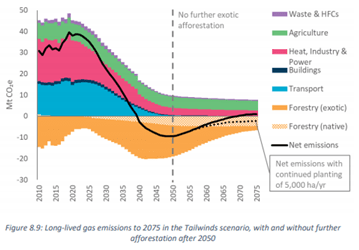
- Yet the CCC’s modelling on forests is highly questionable. Under the amended base case scenario, the CCC sees 1.3 million hectares of forests planted by 2050 assuming a carbon price of $50/t.[12] Yet the CCC also concludes that there is a maximum of “1.4 million hectares of marginal land that could be planted in forestry.”[13] Therefore if all forests planted before 2050 were on marginal land, then that means that pretty much all forests planted after 2050 will be conversions from other productive land. The GDP and emissions impact of that needs to be modelled. The quantity of farm hectares that could realistically be converted to forestry also needs to be modelled, as that will be finite. This proves that New Zealand does not have enough land to plant 5,000 ha/pa of forests ad infinitum to sustain net emissions at zero.
- Even Bill Gates has started tackling climate change in a recommended book to read called ‘How to Avoid a Climate Disaster’. “His focus is on how technology can help us make that journey. … Renewable sources like wind and solar can help us decarbonise electricity but … we are also going to have to decarbonise the other 70% of the world economy – steel, cement, transport systems, fertiliser production [etc.]. … We simply don’t have ways of doing that at the moment for many of these sectors.”[14]
- However, just because Bill Gates is a billionaire and has had success with eradicating polio in Africa[15] doesn’t mean to say he has a monopoly on ideas about solving climate change. ‘Under a White Sky’ by Elizabeth Kolbert implies that industrial revolution and subsequent technology has contributed to the world getting to its current climate situation and therefore queries whether future technology will solve problems (e.g. carbon sequestration) or create more problems (e.g. geo-engineering).[16] That is a very valid train thought.
- There is also a sort of middle ground between Gates and Kolbert[17] in ‘The New Climate War’ by Michael Mann. “[He advocates a strategic, wide-ranging overview of humanity’s present predicament and an exploration of possible pathways out of it. He champions overall system change to decarbonise our civilisation. This involves ethics, politics, finance, communication, psychology, behaviour and belief. Technology … is an important part of the picture, but [he] … warns against over-reliance on unproven fixes such as geoengineering, that distract from simpler, cheaper, safer alternatives.” [18]
- “The continuous development and diffusion of technology is widely recognised to be one of the key distinguishing features of modern and modernising societies.”[19] The CCC’s draft report only cites three areas of technology in existing sectors and notes future potential.
- The rest of the world will go through a similar process as the CCC (because of the Paris Agreement) and they should reach similar conclusions relating to increased localisation, a digital and services economy, the need to export value-add not raw materials, and the need to use technology to displace goods that have a large footprint. Look at Fonterra – it has a long way to fall if other countries localise production or switch to artificial milk. NZ is at risk.
- “Firms [and countries] that control co-specialised assets, like distribution channels, have an advantageous position.”[20] This gives advantage to global players like Fonterra. So science suggests that we should excel in technologies we need or have a comparative advantage in.
- Science recommends a portfolio approach: “Combined market failures [of environmental pollution and those associated with the innovation and diffusion of new technologies] provide a strong rationale for a portfolio of public policies that foster emissions reduction as well as the development and adoption of environmentally beneficial technology.”[21]
Conclusions
- The CCC hasn’t actually set a policy direction for achieving the 2050 target in 2067 or beyond and it needs to according to the Act.[22] That is a big omission in the draft report. That policy direction must include technology.
- New Zealand needs to get on the curve (at a minimum) or become world leaders in (at a maximum) a portfolio of future technology that risks disrupting our economy or that is required for post-2050 emissions reductions. The legwork needs to start soon.
- New Zealand should be agnostic about the type of technology that achieves or better achieves climate change outcomes so as to maximise the chance of future success. A portfolio approach should be pursued.
- Technology represents a good opportunity for getting absolute decoupling of emissions from GDP, despite the scientific uncertainties. However, those uncertainties and risks needs to be properly managed on a national and international level.
Recommendations
- Recommend how Aotearoa can meet and sustain net zero carbon in 2067+.
- Add a chapter or section to the draft report on “anticipated technological developments, including the costs and benefits of early adoption of these in New Zealand” pursuant to r5M(b) of the Act. This should be wide ranging and material.
- Recommend that New Zealand becomes a world leader in artificial meat, so as to mitigate the risk from other countries switching to alternatives.
- Recommend that New Zealand becomes a world leader in methane vaccines, so as to mitigate the risk from other countries localising production or switching to alternatives, and in order to increase the chance that the technology becomes available and is affordable so as to meet emissions reductions required in the second half of the century.
- Recommend that New Zealand becomes a world leader in the sequestration of carbon in olivine in which there is almost 1 trillion tonnes of reserves near Nelson.[23] Permanent sequestration will be game-changing for the world.
- Recommend that a New Zealand team, with government support and/or co-ordination, signs up for the $100m Gigaton Scale Carbon Removal X-Prize, which is a “four-year global competition … [that aims to] pull carbon dioxide directly from the atmosphere or oceans … locking away CO2 permanently in an environmentally benign way”.[24]
- Recommend that New Zealand joins international networks and provides support for nuclear fusion research and development, so that if or when that technology takes off, New Zealand will have the expertise and networks to consider adopting that.
- Recommend that New Zealand leads or participates in green cement and steel production. While the CCC does recommend a plan to plan, [25] it should set direction better.
- Recommend that the Productivity Commission does a comparative advantage analysis for New Zealand including a specific focus on also keeping or increasing localisation of goods required in New Zealand and increasing the value-add to raw materials before export.
- Recommend that New Zealand participates in, and leads, the creation of an international treaty about geo-engineering with objectives about sharing science and research and requiring a high bar if one territory wants to test a geo-engineering technique that poses an existential threat to the world, or a threat to any other territory.
[1] Page 96 of the draft report.
[2] Page 52 of the draft report.
[3] Page 54 of the draft report.
[4] Page 180 of the draft report.
[5] www.britannica.com/technology/ship/History-of-ships
[6] www.reuters.com/article/us-sailing-americascup-idUSKBN27J08F
[7] https://www.rechargenews.com/transition/bill-gates-backed-nuclear-fusion-pioneer-we-can-fill-the-gaps-left-by-wind-and-solar/2-1-887576
[8] https://www.energy.gov/ne/articles/fission-and-fusion-what-difference
[9] https://www.newshub.co.nz/home/election/2017/08/jacinda-ardern-climate-change-is-my-generation-s-nuclear-free-moment.html
[10] Page 129 of the draft report.
[11] Page 16 of https://ccc-production-media.s3.ap-southeast-2.amazonaws.com/public/evidence/advice-report-DRAFT-1ST-FEB/Evidence-CH-08-what-our-future-could-look-like-28-Jan-2021-compressed.pdf
[12] Page 46 of the draft report.
[13] Page 67 of the draft report.
[14] https://www.bbc.com/news/science-environment-56042029
[15] https://www.contagionlive.com/view/wild-polio-is-declared-eliminated-from-africa
[16] https://www.theguardian.com/books/2021/mar/06/it-is-the-question-of-the-century-will-tech-solve-the-climate-crisis-or-make-it-worse
[17] Which is also more aligned with this submission’s proposal for efficiency + consumption reduction + technology.
[18] https://www.theguardian.com/books/2021/mar/06/it-is-the-question-of-the-century-will-tech-solve-the-climate-crisis-or-make-it-worse
[19] https://academic.oup.com/spp/article-abstract/14/4/182/1632834
[20] https://www.researchgate.net/publication/304920449_Profiting_from_technological_innovation_Implications_for_integration_collaboration_licensing_and_public_policy
[21] www.sciencedirect.com/science/article/abs/pii/S0921800905000303
[22] r5ZH(1) requires “direction of the policy required in the emissions reduction plan for that emissions budget period” which must necessarily include the legwork for subsequent periods, otherwise the Act would artificially limit the lead time for new technology to about five years which is not the intent. Further, r5ZG(3)(b) requires “a multi-sector strategy to meet emissions budgets” in the context of a plan for the next budget and r5M(b) (see recommendations) also feeds into the purpose of the CCC.
[23] https://www.stuff.co.nz/environment/climate-news/124199826/scientists-devise-method-to-combat-climate-change-using-common-nz-rock
[24] https://www.xprize.org/prizes/elonmusk – team registrations and full guidelines open on 21 April 2021.
[25] Page 116 of the draft report.
 Chris Boxall