

Appendix 7 – The impact on planetary boundaries is absent, yet that is a key tenet of doughnut economics and sustainability science.
Intro
By now it should be clear that sustainability (of which climate change is but a part) is a paradox with trade-offs. Those trade-offs simply must be understood using modern circular techniques.
The CCC…
- Says that “The Act requires us to think broadly about potential impacts of our advice across the whole system.”[1]
- Only sets out four linear impacts including environment, individuals, social and economy.[2]
- Says “There may be future options for ocean[s] … to remove CO2 from the atmosphere.”[3]
- Says to “Replace coal with biomass and electricity.”[4]
Discussion
- In line with Te Ao Māori, sustainability science says that impact of trade-offs is best done by considering the planetary boundaries which are:[5] ozone depletion, biodiversity loss, chemical pollution, climate change, ocean acidification, freshwater consumption, land system change, nitrogen / phosphorus flows, and atmospheric aerosol loading.
- Doughnut economics[6] says that a circular approach is the best way of analysing social and economic impacts and how they map to the planetary boundaries.
- A 2020 Ministry for the Environment report analysed New Zealand’s impact on five planetary boundaries from a production and consumption perspective:[7]
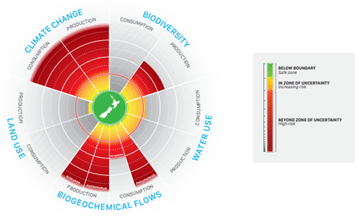
- The same report[8] has two more key points:
- The Paris Agreement is not just about climate change; it is also about ocean acidification, land-use, and nitrogen / phosphorous use.
- The ocean around New Zealand is at its limit for acidification and absorption of CO2 emissions.
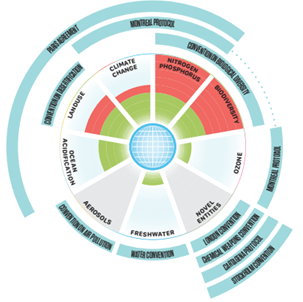
- The same report[9] (by those who invented the planetary boundaries concept) also has a raft of policy ideas from a systems approach specifically targeted to New Zealand, e.g. carbon sequestration incentives.
- Let’s look specifically at the paradox of EVs. EVs have no emissions when they operate (if fuelled from a clean source), but they require lithium to manufacture which consumes a lot of resources. E.g. “each tonne of lithium requires 5.22 tonnes and 35.56 tonnes of brine and pegmatite”[10] and “each tonne of lithium carbonate from spodumene uses 0.48 tonnes of sulfuric acid, 0.52 tonnes of soda ash and 24 tonnes of water”.[11] EV ambitions and excellent recycling estimate that the world will run out of lithium shortly after 2100.[12] If recycling does not improve then issues will start to arise closer to 2040.[13]
- More broadly, science notes that there is a planetary impact associated with material footprint, but has not yet linked it with the planetary boundaries, i.e.:
- “The total amount of 70 billion t of raw material extraction is unprecedented, and per-capita levels of resource consumption are at their highest level in history (10.5 t/cap in 2008). These numbers are predicted to rise unless stringent reduction targets and policies are put in place.”[14]
- “A sustainable material footprint benchmark of 8 tonnes per person per year as a resource cap target for household consumption in Finland [is a good idea].”[15]
- Biomass may be an okay policy option, but it pollutes and affects air quality.[16] [17] In addition to those planetary boundary / social trade-offs is the question about the impact of slash removal on tree nutrients, productivity and emissions sequestration.[18]
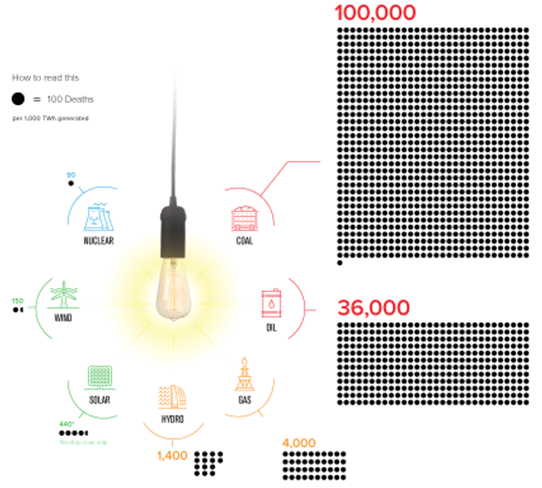
- Even though coal is (in theory) on the way out and is commonly understood to pollute twice as much as the worst geothermal plant in New Zealand, few understand the comparative impact it has on deaths which is illustrated below:[19]
Conclusions
- An expert group engaged to consider broad impacts that does not consider the planetary boundaries is not an expert group, particularly when New Zealand has already taken steps down this path. This omission undermines the CCC’s credibility.
- Key solutions posed by the CCC, i.e. EVs and biomass, have massive trade-offs that are not noted or discussed in the draft report.
Recommendations
- Provide a planetary boundaries and/or doughnut economic visual and descriptive analysis of each policy direction and recommendation so the true domestic and global impact of any policy option stemming from those can be wholly considered (including where emissions are offshored under the guise of meeting domestic targets).
- Deep dive into the trade-offs associated with increased forestry, and the impact of land use changes on rural communities.
- Deep dive into the trade-offs associated with EVs, in particular the use of rare earth and other metals.
- Deep dive into the multiple trade-offs associated with biomass and be cautious about recommending that as a policy direction subject to further bespoke New Zealand research.
- Add a chapter or section on “the principal risks and uncertainties associated with emissions reductions and removals” on each policy direction pursuant to rZC(2)(a)(ii) of the Act.
- Use more nuanced language regarding ocean sequestration (e.g. with seaweed) given that oceans themselves cannot safely store more carbon without damaging its planetary boundary.
[1] Page 5 of https://ccc-production-media.s3.ap-southeast-2.amazonaws.com/public/evidence/advice-report-DRAFT-1ST-FEB/Evidence-Intro-20-Jan-2021.pdf
[2] Page 5 of https://ccc-production-media.s3.ap-southeast-2.amazonaws.com/public/evidence/advice-report-DRAFT-1ST-FEB/Evidence-Intro-20-Jan-2021.pdf
[3] Page 4 of https://ccc-production-media.s3.ap-southeast-2.amazonaws.com/public/evidence/advice-report-DRAFT-1ST-FEB/Evidence-CH-05-Removing-carbon-from-our-atmosphere-19-Jan-2021.pdf
[4] Page 55 of the draft report.
[5] www.stockholmresilience.org/research/planetary-boundaries/planetary-boundaries/about-the-research/the-nine-planetary-boundaries.html
[6] www.kateraworth.com/doughnut/
[7] https://www.mfe.govt.nz/sites/default/files/media/Climate%20Change/a-safe-operating-space-for-nz-aotearoa.pdf
[8] At page 54.
[9] At page 57.
[10] https://link.springer.com/article/10.1007/s11837-013-0666-4
[11] https://link.springer.com/article/10.1007/s11837-013-0666-4/tables/1
[12] www.pv-magazine.com/2020/09/15/how-long-will-the-lithium-supply-last/
[13] www.pv-magazine.com/2020/09/15/how-long-will-the-lithium-supply-last/
[14] https://www.ncbi.nlm.nih.gov/pmc/articles/PMC4443380/
[15] https://aaltodoc.aalto.fi/handle/123456789/31300
[16] https://www.pfpi.net/air-pollution-2
[17] http://aqma5.co.uk/_assets/AQEG_Biomass_Combustion_report_Defra_2017.pdf
[18] https://mff.forest.mtu.edu/Biomass/BiomassDocs/LoggingResidueReport.pdf
[19] https://www.visualcapitalist.com/worlds-safest-source-energy/
 Chris Boxall