
Sustainability is more than just a buzz-word – it is what is required if we are going to take humanity deep into the future. This drives me. I became hooked on sustainability when three disparate things converged:
- First, in 2016 I went to the SingularityU New Zealand Summit – where the focus was on tools and futures and ideas.
- Second, in 2018 I entered a competition by Narrative Imperative about the United Nations Sustainable Development Goals – a framework for humanity to become more sustainable for itself and the planet.
- Third, in 2019 I attended a talk at my children’s primary school where they were trialling play-based learning in the junior school.
As I tend to do when I want something – I just do it. I run with it. I run with inbuilt catalysts of energy, ideas, flow, and curiosity. And so started my Sustainability Quest. It has four elements:
- Piloting ‘Sustainability Quest’ [completed]
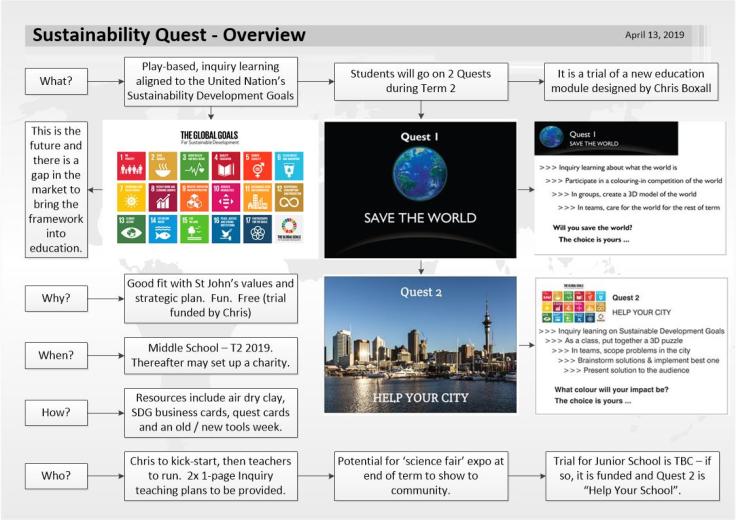 St John’s Mairangi Bay School kindly agreed to pilot my Sustainability Quest. This saw me teach (as a parent / volunteer) three Y3/4 classes for 12 weeks in Term 2 and the start of Term 3, 2019. I taught for 1/2 hr per class most weeks, with the teachers doing an awesome job when I wasn’t there. The solution I offered was how to teach sustainability.
-
- Week 1 – a perpetual motion engine, a class brainstorming session on what is sustainability, colouring competitions, students choose criteria to judge other classes’ colouring in, and presentation of goody bags (including air dry clay, a game pack of SDG cards, quest cards etc.).
- Learning outcome: understand what sustainability is and that it is fun.
- Teaching outcome: buzz created with full engagement.
- Week 2 – Quest 1: in teams of 2-4 students put air-dry clay around a small-ish balloon, students judged other classes’ colouring in.
- Learning outcome: understanding how fragile the world is.
- Teaching outcome: there was a certain amount of order in unstructured chaos where the objective was clear but there were no rules to follow.
- Week 3 – Quest 2: the whole class made 17 small boxes and covered them in colours and pictures relating to the SDGs, then organised those into a 3D structure which was kept for the term.
- Learning outcome: introduction to the SDGs and to create/solve a puzzle.
- Teaching outcome: as for week 2 but needed more facilitating.
- Week 4 – Form groups based on self-directed SDG interests. Each group had to look after an air-dry clay world for the rest of the term taking week-long turns. Name the group, talk about why they chose that SDG.
- Learning outcome: to collaboratively identify sustainability interests.
- Teaching outcome: a slower prep week which was needed.
- Week 5 – Each group brainstormed specific problems relating to their SDG in the context of the school, the city or the world, often researching detail online.
- Learning outcome: to brainstorm problems and identify one to solve.
- Teaching outcome: coaching the students to lead their own discussions / research.
- Week 6 – Science expo – all three classes walk into the hall and go around the stalls including art and craft, tesla lamp, salt lamp, solar powered toy car, magic sand, levitating globe, tesla coil, and drone.
- Learning outcome: to learn that creativity and tools can help solve problems.
- Teaching outcome: this is how to deliver awe.
- Week 7 – Hackathon with post-it notes for the students, in teams, to scope solutions to their problems.
- Learning outcome: to explore ideas for a solution and choose one.
- Teaching outcome: a bit advanced for Y3/4s, but fun nonetheless.
- Week 8 to 11 – In their teams, students research and create a solution or prototype of a solution to their chosen SDG problem.
- Learning outcome: to implement an action plan and deliver a solution.
- Teaching outcome: role is more of a coach than a traditional teacher.
- Week 12 – Presentations in front of the class and Middle School.
- Learning outcome: to succeed or fail at saving the world and helping the school or city.
- Teaching outcome: great to see all the students proudly present.
- Week 1 – a perpetual motion engine, a class brainstorming session on what is sustainability, colouring competitions, students choose criteria to judge other classes’ colouring in, and presentation of goody bags (including air dry clay, a game pack of SDG cards, quest cards etc.).
Feedback from teachers and students was amazing. Student engagement was close to 100% each lesson and I think they really enjoyed the creative inquiry learning based approach. There was a propensity for the students to want to research and present on problems – rather than design or do solutions, but that can be fixed.
Other positives were seeing students who struggle with tranditional learning methods really thrive in a play-based environment. And the stretch-nature of the module allowed those who wanted to extend themselves unlimited freedom to do so – e.g. the presentations included a drama and a plan to set up a charity.
2. Education [Never Completed]
I really enjoyed teaching – I knew I would, having done a bit of theatre and comedy performance at university. Prompts from teachers for me to study the craft were appreciated and justified my thoughts from my early 20s to consider the craft.
But one of life’s lessons is that finite time creates tradeoffs and it is sustainability that is on my radar. Truth be told, it was flattering to be called an ‘expert’ in sustainability when really all I had was an idea, passion, a vision, lots of reading and deep expertise in climate change which is only 1 of 17 of the SDGs.
And so, in:
- 2020 – I was offered and accepted a place on MSc Sustainable Development, online part-time at the University of Sussex. So far I am studying or have studied:
- Module 1 – Science, Technology and Innovation (Merit), with specific focus on Hydrogen and Nuclear technology in New Zealand (>> SDG 7). Key learnings:
- Traditional economic growth and innovation theories (e.g. entrepreneurs and systems’ push for profit) require more modernization for pursuing sustainability (e.g. doughnut economics’ push for purpose).
- Science, technology and innovation are interrelated – technology is the know-how, innovation is the taking to market, and science is often the retrospective study of something. Be careful of technological lock-in.
- Innovation pertains to invention plus commercialization, although it could swap the latter for operationalization.
- Some good, like re-centered kindness, might result from COVID-19 and further address some of capitalism’s shortcomings – yet sustainability outcomes are correlated to GDP (to a point).
- Economic inequality harms societies.
- Comparative advantage is to countries what competitive advantage is to companies.
- New Zealand is correct to support green hydrogen but should remain open to blue hydrogen (and other technologies) – the key is the net zero carbon end, not the means.
- New Zealand should progress conversations about nuclear fusion (byproducts are hydrogen and helium), so it can adapt at speed should this technology take off.
- Nuclear energy is one of the safest and cleanest of all energy technologies.
- Green growth is a paradox which may switch climate change solutions for rare earth metal / resource mining problems.
- Nevertheless, climate change is a pervasive problem which requires immediate and sustained action. The world should iteratively / quickly update its kit for the most efficient and clean technologies.
- Module 2 – Sustainable Development: Politics and Policies (Pass), with specific focus on Child Poverty Reduction in New Zealand (>> SDG 1). Key learnings:
- Sustainability is most often defined by the Brundtland report, and is about present generations doing what they want without negatively affecting future generations.
- Sustainability is often portrayed as three interlinking circles: Environment, Economy, and Social.
- My personal footprint was 4.4 Earths at the start of the module, but since we have reduced meat and swapped some for plant based alternatives.
- The UN’s SDGs are capitalist in their construct and have many negatives, yet the story and symbolism will help more people vs. not having a successor to the MDGs.
- There is a pluriverse of visions that could be an alternative post the SDGs.
- New Zealand has a proud history of feminist economics, which pertains to valuing care.
- There is no reputable empirical evidence for long-term absolute decoupling of GDP from emissions (as at 2020), meaning even with green growth, Paris and 2050 net zero carbon visions will require reductions in consumption (and likely GDP) if they are to be achieved.
- While Britain did meet its Kyoto targets, this was as a result of de-industrialization and the switch from coal to gas fired power generation. If this is adjusted for, and shipping and aviation is added back in, then carbon consumption rose by ~20% from 1990 to 2005.
- Numerous lenses can be applied to policy development including politics of scale, degrowth, cultures of control and care, and STEPS (iterative circular conversations that aim to present different pathways, not just one).
- The 9 planetary boundaries are critical in understanding how we can live within our means; e.g. ocean acidification, ozone depletion, freshwater use and climate change.
- I’d like to see us break free from the anthropocene era by still having humanity; as nature will adapt with or without humans. We all need our own manifesto or sustainability quest to limit adverse impact on the planet.
- Lacanian psychoanalysis is a powerful concept which assesses the real, the symbolic and the imaginary and often explains why impossibilities are zhuzhed-up with symbolism such that people believe a fantasy outcome despite the logical shortcomings or evidence to the contrary.
- New Zealand budgets’ requirement for a child poverty reduction report are unlikely in and of itself to reduce child poverty. The policy isn’t just for poverty reduction purposes but also for political purposes such as progressing wellbeing discourses.
- Need to decouple poverty from pertaining to income and instead define it by access to a basket of goods, services and conditions.
- Module 3 – Policy Analysis (Distinction), with specific focus on Plastic Pollution in Waterways in Japan (>> SDG 12). Key learnings:
- Signed up to and hosted first Zoom meeting.
- Spillover benefits to study – my children:
- Produced an into video.
- Want to become scientists.
- (aged 6) ask questions like ‘what happens when a white hole fights with a black hole’?
- Difference between equality (i.e. outcome pertaining to equal) and equity (i.e. fairness); and the quest to reduce inequality will itself create inequity.
- Inequality harms society as it leads to weak aggregate demand, inequality of opportunity and less public investments. This can be fixed by limiting excessive executive compensation, investing in education, implementing economically stable macro-economic policies and fairly and fully taking capital income.
- Regulatory capture is when an organization becomes captured by the party who it was meant to oversee or regulate. Elements of this were at play in the Fukushima nuclear disaster.
- Corporate Social Responsibility is the sacrifice of profits for the social interest.
- Externality theory is powerful for describing abstract issues such as the Great Pacific Garbage Patch which is a mass of floating plastic in the Pacific the size of Texas.
- Public choice theory assumes that actors in society focus on their own self-interests.
- Policy analysis follows a problem definition, policy option, recommendation approach to propose what is effectively the ‘next best’ thing to do about a specific problem. Incremental change is the usual result. If a vision, or radical change, could be pursued instead or as part of an iterative set of steps, that would have profound impact.
- Plastics in Japan are ubiquitous but can be reduced by using a hypothecated tax and increasing the focus on composting and recycling. Countries should not export waste or recycling.
- Module 4 – Understanding the Policy Making Process (Merit), with specific focus on Conflict in Antarctica (>> SDG 16 & 17). Key learnings:
- Created a visual thought bubble.
- Policy should be equally about agenda setting and implementation as one without the other will result in failure.
- Actors in all roles are very important, as are veto players around whom compromises may be worked.
- The way problems are framed, including who the villain is, is important and helps social problems become policy problems.
- The media have a crucial role in framing, however, I think we need to:
- Call out irrationality, bias, and unfairly narrowing the framing.
- Demand implementation from policy, not just nice-sounding narrative.
- Reject poor leadership that doesn’t ‘do the right thing’.
- Refrain from accepting the news at face value, but rather form a considered, researched opinion.
- Reject mass-media if it isn’t serving your purpose, in favour of targeted media (with a variety of viewpoints) that does.
- Some problems are wicked problems, i.e. the solution is not obvious and/or involves a paradoxical trade-off.
- Agenda frameworks include rationalism, incrementalism, punctuated equilibrium theory.
- SDG implementation seems experimental.
- Accountability is critical – for self and others – it’s about leadership and substance.
- Module 1 – Science, Technology and Innovation (Merit), with specific focus on Hydrogen and Nuclear technology in New Zealand (>> SDG 7). Key learnings:
-
- Module 5 – Perspectives, Methods and Skills (Distinction), with specific focus on Guardianship of Rivers in New Zealand (SDGs 6, 12 & 17) and the Resilience of Syrian Youth Refugees (>> SDG 3 & 16). Key learnings:
- Rich pictures and diagramming are a good way of first ‘painting’ a messy situation.
- Systems thinking (and design thinking) are powerful problem solving techniques:
- Systems thinking is broad and looks at overall patterns and cycles, not just an event.
- Design thinking combines economically and technologically doable things to creatively get outcomes.
- A “Louis Pasteur” quadrant applies to the best research questions, i.e. those that are socially relevant and that improve a fundamental understanding in life.
- I developed my own self-reflexive scientific framework including my ontology (reality), epistemology (knowledge), axiology (values), participatory approach and research paradigm.
- Learning the discourses of movement are important, otherwise cut-through will be difficult.
- Tools of inquiry are important to coding discourse, e.g. figured worlds, situated meanings, conversations and social relations.
- Syrian refugees need more help and that could potentially be achieves by host countries putting more resources and time into identity and community of the refugees.
- Module 5 – Perspectives, Methods and Skills (Distinction), with specific focus on Guardianship of Rivers in New Zealand (SDGs 6, 12 & 17) and the Resilience of Syrian Youth Refugees (>> SDG 3 & 16). Key learnings:
- 2019 – I attended:
- An Auckland Writers Festival conversation Doughnut Economics with Kate Raworth.
- The 2019 SDG Summit in Auckland.
- 2019 – I completed:
- The SDGAcademyX course Transforming Our World: Achieving The Sustainable Development Goals via edx.
- The Columbia University course The Age of Sustainable Development via Coursera taught by Jeffrey Sachs.
- 2019 – I became a member of the:
- Sustainable Business Network.
- United Nations Association of New Zealand.
- International Development Young Professionals Aotearoa New Zealand Incorporated.
3. Giving Back at the Grass Roots [in progress]
Like with my writing, I want to give back a bit first to positively impact real people in everyday life. This is also a way to leverage most of my time – i.e. my ‘career’ – and transition that into sustainability in the long-term. Or rather, to converge my paid work with my various moonshoots. The plan is:
- First – refer to 1. above.
- Second – I am an active member of the Auckland Branch including:
- Being the UNA Advisor for SDG1 – No Poverty from August 2020 onwards.
- Helped organize, and attended, the UNANZ National Council Meeting in Auckland in November 2020.
- Third – I would like to influence at my current company and see if it can do more in the sustainability, climate change, and renewables space.
Early days, but exciting times…
4. Sustainability Quest as a Social Enterprise [on hold]
After the success of my Sustainability Quest pilot, I grappled with the sustainability of the concept as a social enterprise.
I did two things to bide time. First, I purchased http://www.sustainabilityquest.com which I still own. Second, I registered an appropriate name with the New Zealand Companies Office wherein you have one month to incorporate a company, extend the application, or let the name lapse. I extended the application for three or four months before letting the name lapse.
It is unlike me to make such a slow decision, but I was determined to get the decision right. Ultimately, I concluded that:
-
- Sustainability always has tradeoffs – and I was unwilling to dilute my family relationships for an unknown time commitment at the present time.
- If focusing on a company that was not my day job, effort should be on our current company – in particular supporting my wife re-enter the workforce.
- The world needs ideas like this, but they can be pursued by others, or by me later – and positive impact can take a number of different forms.
- I am very good at compartmentalising in order to leverage action, and I already do a lot.
- Trying to achieve all my moonshoots at once will minimise success. Moonshoots are visions, and success will be maximised if I focus on no more than 4 or 5 at a time.
- There are parallels with the point above and the UN’s SDGs – it is an inconvenient truth about using finite resources to transform history.
- I am on my own Sustainability Quest as much as the world and others are also own their own quests.
- There is a long game at play here – hence 2. and 3. above.
- In the meantime I can democratise my idea – hence my playbook in 1. above.
Therefore this part of my Sustainability Quest is on hold on / from 2019 until further notice.
 Chris Boxall